RCFP welcomes new legal fellow focused on supporting documentary filmmakers
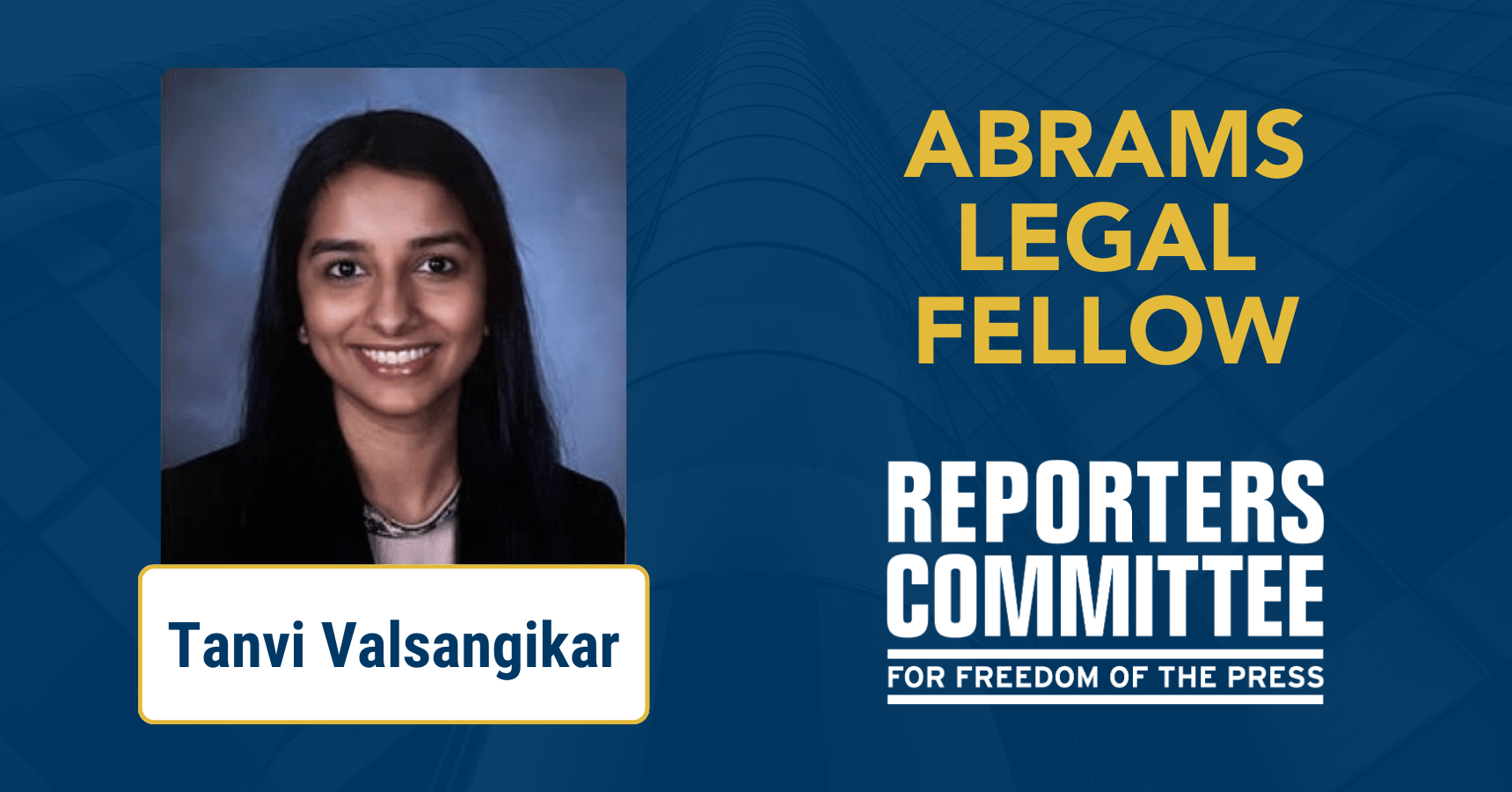
In January, Tanvi Valsangikar joined the Reporters Committee for Freedom of the Press as its inaugural Abrams Legal Fellow, a two-year position that focuses on providing free legal assistance to documentary filmmakers. The fellow’s primary client is FRONTLINE, the award-winning PBS documentary series produced by GBH in Boston.
Valsangikar’s hiring comes as the Reporters Committee is expanding its pre-publication review program for journalists and documentary filmmakers in response to a growing need. A graduate of Rutgers Law School, Valsangikar most recently worked as legal counsel at Springer Nature Group, where she handled pre-publication review and contract negotiations.
Reporters Committee Staff Writer Emily Vespa recently sat down with Valsangikar to talk about her experience and her new role. In the conversation below, Valsangikar discusses the nuances of pre-publication review for visual journalism, why free legal vetting is an important resource for documentary filmmakers, and what most excites her about the Abrams fellowship.
What first sparked your interest in media law?
I’ve always been a huge reader, and I dabbled in creative writing. So when I started law school, I knew I wanted to focus on working with authors or other content creators, but at the time I thought that meant focusing exclusively on copyright law. Through an internship with Penguin Random House, I learned how central the First Amendment is to working with content and was exposed to a wide range of First Amendment issues: dealing with defamation, privacy, right of publicity, doing rights clearance, fair use, and all that kind of work. It just opened my eyes to how varied the field is.
I love the idea of helping to shape content through legal work and being able to dive into stories across the world through books or journalism or documentaries or other content. That combination of the intellectual challenge and getting to work with storytelling really drew me to media law and keeps me interested in it.
How did your background in media law prepare you for this position?
From my first year of law school, knowing I was interested in media law, I was really intentional about the work experience I pursued. I worked with Penguin Random House as a legal intern for my 2L summer and all throughout my third year of law school, which led to the incredible opportunity of being their first-ever legal fellow. In that role, I really got to dive into that work full time and work on nonfiction manuscripts and advise on First Amendment issues, copyright issues, and just understand how a publisher works.
In my previous role [at Springer Nature Group], I got to expand on that experience. I went beyond just vetting print articles or print journalism to dealing with multimedia projects — I worked on docuseries, podcasts, TikToks or YouTube explainer videos. Experiencing the full spectrum of storytelling across different formats and different platforms taught me the mechanics of the work, and it allowed me to dive a little bit more deeply into media law across platforms.
What interested you most about this role at the Reporters Committee?
Expanding my pre-publication review work from print into visual media sparked my interest in the First Amendment issues in visual journalism. When you’re working with documentaries or other visual journalism, there are unique nuances: The way that you frame a shot, or the lighting that you choose, or even the music that you use in the background, it all adds to and conveys the message in a way that just print on its own doesn’t. So when I saw that this fellowship offered an opportunity to specifically work with documentary filmmakers, I was excited about the chance to immerse myself in that field.
What excites you most about this fellowship?
I’ve seen how legal guidance, when it’s done thoughtfully, empowers creative work, rather than limiting it or restricting it. I enjoy being a part of that process and helping shape the real-time decisions that journalists, authors, documentarians, or producers make about their work. Being able to see the results of that collaboration in the end product and being able to support public-interest journalism is extremely motivating for me.
I also really enjoy working with content because of the variety it offers, and I like that each project can be about a completely different topic . In my previous roles, just reading articles or working on manuscripts exposed me to a lot of subject matter that I wouldn’t have come across otherwise. So the chance to work with documentarians and learn from the stories they’re telling about people, places, and ideas that are completely new to me is very exciting.
Why do you think providing free pre-publication legal assistance to documentary filmmakers is important?
Documentary filmmakers are often working with real people and sensitive subject matter. If they’re covering something like an ongoing court case or investigation, the story can change or evolve in real time, and they have to keep up with that. Having legal guidance early on can help filmmakers understand their options and tell the story they want to tell without constantly second-guessing their own instincts.
When lawyers are involved at the pre-publication stage, they can help identify potential risks, suggest alternative approaches, and think through the content early on. That kind of support gives filmmakers the confidence to move forward with their work. Ultimately, the goal is to ensure that important journalism reaches the public.