RCFP’s national litigation program is growing. Meet the longtime RCFP attorney promoted to lead it.
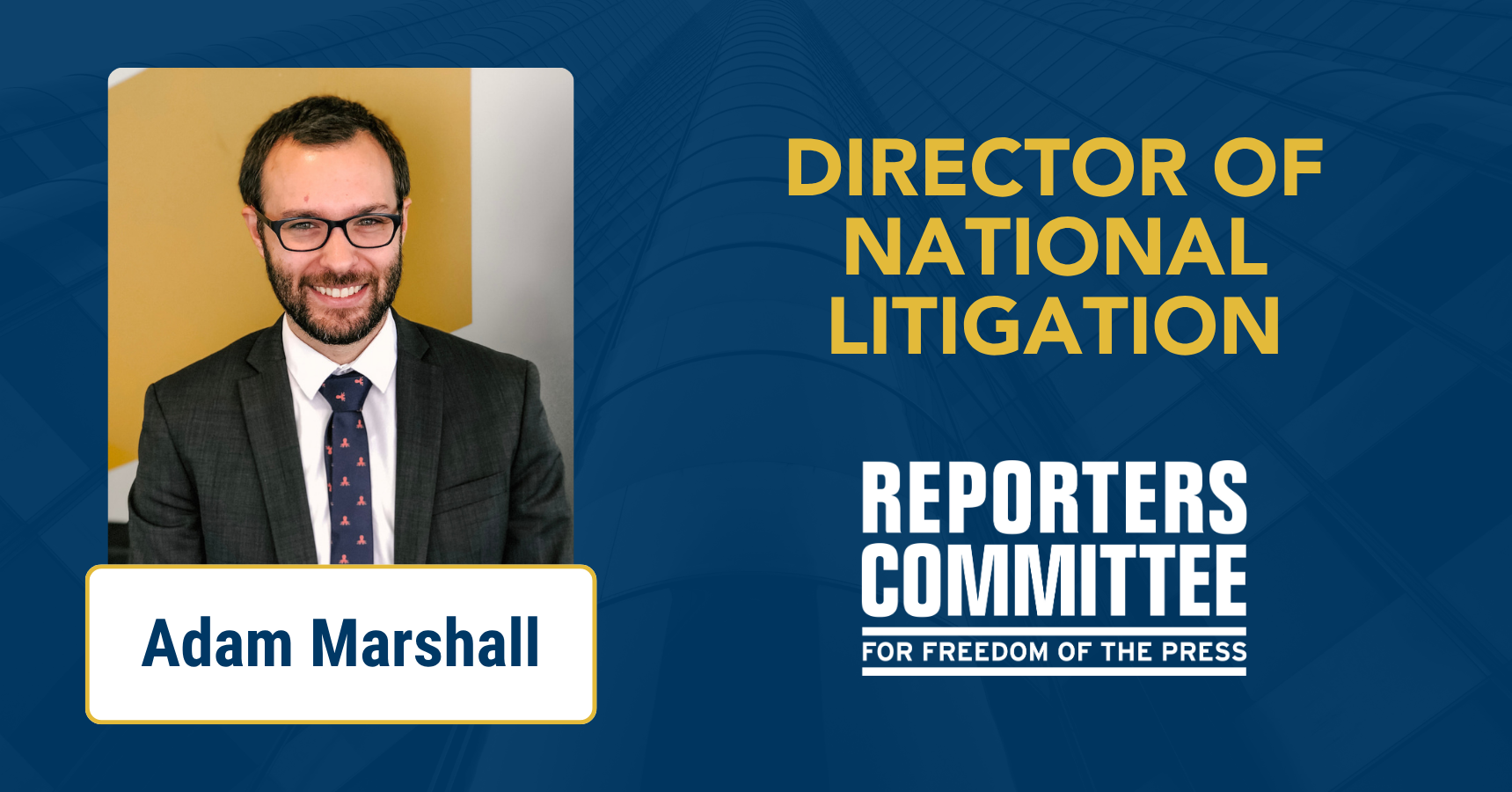
When Adam Marshall joined the Reporters Committee for Freedom of the Press in 2014, the organization was the epitome of a small nonprofit: The team consisted of an executive director, two permanent staff attorneys, a handful of legal fellows (Marshall included), and a couple of support staff — and each of them wore plenty of hats.
“I remember in my first weeks at the Reporters Committee both writing a Sixth Circuit amicus brief and also trying to figure out how to order copy paper,” he says. “We were involved in all parts of running the organization.”
At the time, the Reporters Committee’s work involved fielding Legal Hotline calls, drafting friend-of-the-court briefs, producing legal guides, and publishing a journal about press freedom issues. What the organization didn’t do back then was engage in direct litigation on behalf of journalists and news outlets.
That changed in late 2014, when the Reporters Committee hired Katie Townsend as its first litigation director. Under her leadership, the Reporters Committee built a powerhouse litigation program, taking on important cases concerning the newsgathering and First Amendment rights of journalists and ushering in what Marshall calls the “modern era” of the Reporters Committee.
Today, the Reporters Committee is the largest nonprofit whose attorneys offer direct legal services to the news media in the United States. The Reporters Committee’s legal team, led by Vice President of Legal Programs Lisa Zycherman, now consists of more than 20 full-time attorneys. Our Local Legal Initiative attorneys provide free legal support to local journalists and newsrooms in five states — with four more coming soon — while our national litigation program based out of Washington, D.C., handles an ever-expanding caseload at the federal and state level. The organization also serves journalists through its successful amicus, policy, pre-publication review, and Legal Hotline practices, as well as through its comprehensive collection of legal guides and resources.
As the Reporters Committee has grown, so has Marshall’s role within the organization. For more than 11 years, Marshall served as a legal fellow, staff attorney, and senior staff attorney, positions in which his work focused primarily on litigating cases related to government transparency and access to public records.
Now, Marshall is stepping into a new role: director of national litigation. In this position, he will oversee the Reporters Committee’s attorneys on the newly formed national litigation team, advancing both federal and state cases, including cases involving the Trump administration. Marshall steps into this role at a tumultuous time for press freedom, when journalists and newsrooms are increasingly facing legal hurdles and threats as they report on everything from immigration and public health to policing and presidential power.
Reporters Committee Senior Editorial Manager Chris Young recently sat down with Marshall to look back at his decade-long career litigating public records cases at RCFP — and to look ahead to his top priorities as he begins his new role leading the national litigation program. In the conversation below, Marshall discusses his favorite Freedom of Information Act victories, the state of government transparency under the Trump administration, and why litigating cases at the Reporters Committee is “one of the coolest jobs that exists.”
The bulk of your work at the Reporters Committee has focused on government transparency and litigating Freedom of Information Act cases. What sparked your interest in this kind of work?
It was kind of an accident. I went to law school not knowing what I wanted to do, and for a while I thought I would apply to be a public defender. But a couple of things steered me toward FOIA. I had some internships during law school with nonprofits that used FOIA to further their goals, and I also had a constitutional law professor, Alan Morrison, who litigated a lot of seminal FOIA cases with the Public Citizen Litigation Group. I began to realize that government transparency was something that resonated with me as a way of promoting democracy within the United States.
I came to see the goal — making information about the government available to the public — was actually something I had been working on for a long time. In high school, I started a newsletter with one of my friends about the Iraq War. Distributing information to my classmates was both important and satisfying, because they didn’t know a lot of what was occurring. In college, I spent a lot of time studying democratic theory and conceptions of the public sphere, looking at how information flows can facilitate political action. When I got to law school, I realized FOIA litigation was a tool to effectuate a goal I had already been working on for years.
What do you enjoy most about your job as an attorney at the Reporters Committee?
My job is to find journalists who are trying to get information about important issues, and then use my tools and my skills as a lawyer to get them that information so that they can inform the public. It is one of the coolest jobs that exists.
It’s hard. It doesn’t always work out. And it is often a mind-numbing exercise dealing with government bureaucracy. But when you do succeed and you get records that allow for a transformational story to be brought to the public, it makes it all worth it.
Are there cases you’ve litigated that you are most proud of?
Working on FOIA cases for Azmat Khan has been one of the greatest privileges in my time at the Reporters Committee. Azmat is such a dedicated and tenacious journalist, and she identified an important gap in the public’s understanding of what was happening in our air wars in the Middle East and the civilian casualties they were causing. Seeing the records we helped Azmat obtain via FOIA appear on the front page of The New York Times, and then for Azmat and her reporting team to win the Pulitzer Prize in International Reporting for that, it was just the best. I am so happy to have played a small role in her reporting.
I am also incredibly proud of the work that we did for Ziva Branstetter and Tulsa World, which was one of the first cases that former Reporters Committee Legal Director Katie Townsend and I litigated in Oklahoma back in 2014. That case involved trying to access information about the botched execution of Clayton Lockett. It also involved important legal questions concerning access to public records in Oklahoma. I learned so much during that case — about litigation, about public records, about how to navigate the lifespan of a matter. But most importantly, we helped Ziva and Tulsa World access records that they used to shed light on Lockett’s execution, reporting that was later recognized as a finalist for a Pulitzer Prize.
OK, one more: Representing Steve Coll in his lawsuit against the U.S. Department of Defense to get records for his book, “The Achilles Trap,” was incredible. As I mentioned, the United States’ invasion of Iraq was a really formative moment for me in high school. To be in a position many years later to help Steve get records about the relationship between the U.S. and Iraq was really a full-circle moment for me.
During your time at the Reporters Committee, you have litigated FOIA cases across several presidential administrations. How does the second Trump administration compare to previous administrations when it comes to accessing public records at federal agencies?
It’s bad. Looking at long-term FOIA trends over administrations, I think a few things become clear. One is that, as a general matter, FOIA tends to get worse over time. Generally, the delays have increased and the amount of information withheld has increased. Both of those make it very difficult for reporters to use FOIA as a tool for even remotely contemporaneous reporting.
A big reason for the increased delays is a lack of resources. Federal agencies don’t give enough personnel or technology to the FOIA shops that are responsible for responding to requests. And one thing we’ve seen in the current administration is large-scale layoffs, firings, and reductions in force across many federal agencies, which have an impact on FOIA offices. And so those shops that are already strapped for resources are now, in some cases, decimated. That is going to have an increasing effect on how FOIA requests are responded to, and I anticipate over the next year the delays are going to spike.
We’ve also seen a couple of affirmative efforts by different agencies in this administration to mass cancel FOIA requests. These are unprecedented efforts. We have both the Department of Energy and the Agency for International Development telling requesters that unless you affirmatively reach out to us, we’re going to cancel all FOIA requests that were filed before a certain date. To attempt to cancel or close broad swaths of FOIA requests like this is something I’ve never seen before.
You and your team have recently filed several FOIA lawsuits against federal agencies related to immigration, public health, government censorship, and more. Are these lawsuits part of a broader litigation strategy?
While I can’t get into specifics on case strategy, it’s true that in the last few months our attorneys have been bringing more FOIA cases, especially where reporters and news organizations have been stymied in getting records on some of the most pressing and newsworthy issues in the United States right now. I’m very proud of our efforts in these cases because people have a right to know about what their government is doing, whether it’s the basis for immigration-related detentions or the efforts of the Federal Communications Commission to investigate news media organizations. Democracy can’t function without an informed public, so we’re doing what we can to pry information out of the government.
What are some of your top priorities as you begin your new role as the Reporters Committee’s director of national litigation?
I’m incredibly lucky to work with a team of attorneys who are so capable on such a wide variety of issues affecting newsrooms and reporters. I want to empower the national team to keep up their incredible work, but also to explore new frontiers in access and accountability litigation. At the same time, we need to be ready to respond to emergencies that come our way, and unfortunately the pace of those emergencies is increasing. It’s going to be a challenge balancing our proactive cases and responding to press freedom threats, and that’s one reason why we’re going to be hiring new staff and building out our infrastructure.
In the last few months, we’ve seen so many disturbing threats to reporters and newsrooms in the United States — from the White House, to regulatory agencies, to local law enforcement. We’ve got to keep growing and developing the Reporters Committee’s national team to meet those challenges and defend the free press. And we will.
The Reporters Committee for Freedom of the Press is the leading pro bono legal services provider for journalists and news organizations in the United States, offering direct legal representation, amicus curiae support, and other legal resources to protect First Amendment freedoms and the newsgathering rights of journalists. Stay up-to-date on our work by signing up for our newsletters and following us on Bluesky, LinkedIn, Instagram, and Facebook.