Breaking down the Gray Lady’s lawsuit against the Pentagon
If you like this post, sign up to get The Nuance newsletter delivered straight to your inbox every month!
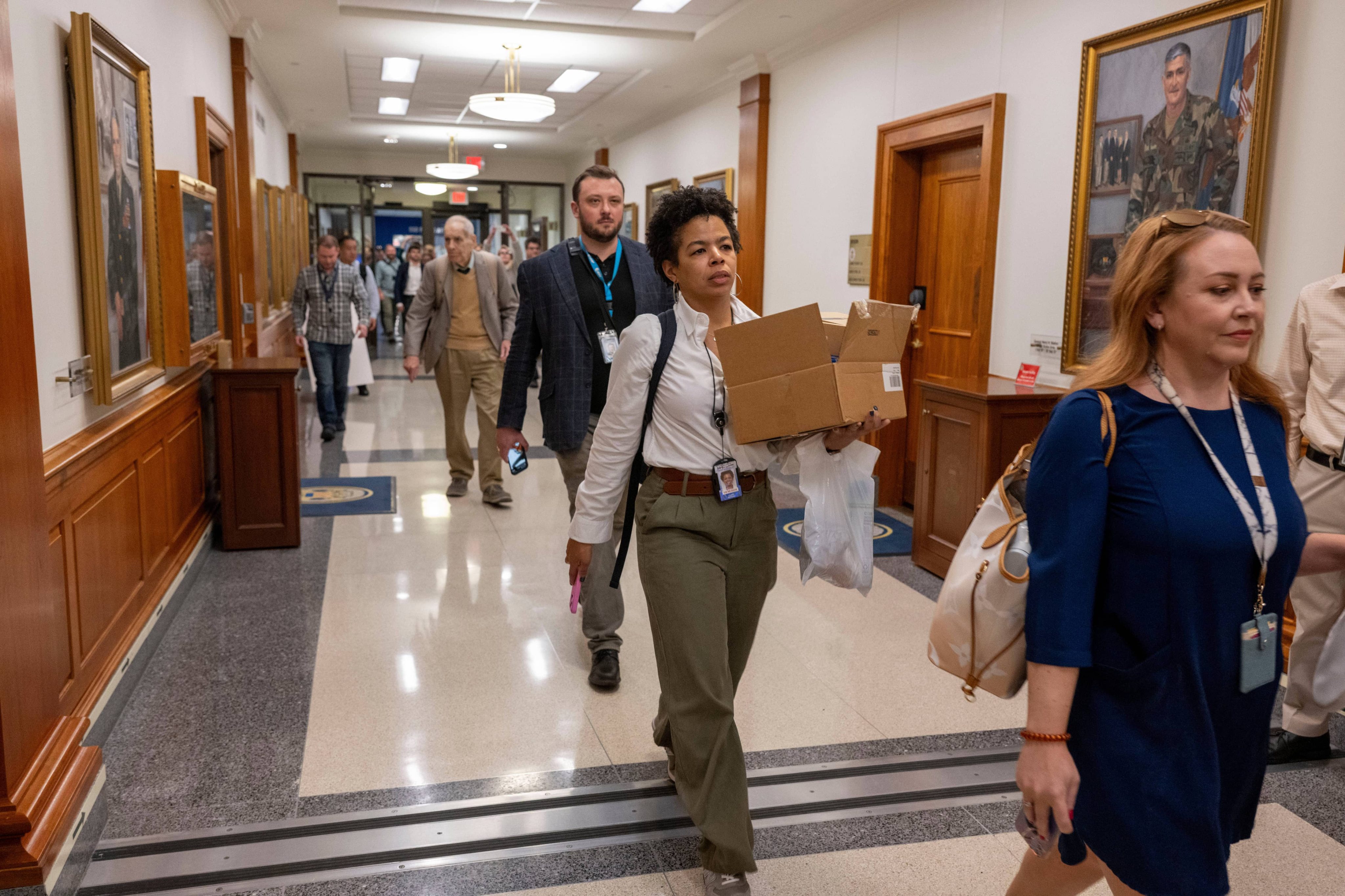
It’s been two months since virtually the entire Pentagon press corps were forced to turn in their credentials following the U.S. Department of Defense’s imposition of a new policy that could put those credentials in jeopardy for acts of journalism.
The most recent development in the controversy is The New York Times’s lawsuit, filed in the first week of December, claiming that the new Pentagon policy violates the First Amendment. We thought a short summary and explainer of the legal theories advanced by the Gray Lady might be helpful for this edition of our newsletter.
First, however, a bit of scene setting. Less than two weeks after the inauguration, and seven days after Secretary of Defense Pete Hegseth assumed office, the Pentagon announced a new “rotation” program removing certain major news outlets from their dedicated spaces in the building in favor of other outlets.
Then, in May, the Defense Department restricted physical press access further. In a memorandum to the press corps, the Pentagon limited unescorted access in designated areas to, it said, “reduce the opportunities for in-person inadvertent and unauthorized disclosures.” The memo stated that journalists holding press passes granting them access to the Pentagon would have to sign a new “in-brief form” to maintain those credentials.
That new form came in late September and, to put it mildly, made a splash. The form said that Department of Defense “information must be approved for public release by an appropriate authorizing official before it is released, even if it is unclassified” and that the unauthorized release of classified or controlled-but-unclassified information “poses a security risk that could damage the security of the United States.” Journalists found to pose a security risk could have their press credentials revoked, suspended, or denied, which would also limit their physical access to other military facilities worldwide.
Many read that language as requiring Pentagon review of news reporting prior to publication and outcry naturally followed. We sent a letter to chief Pentagon spokesperson Sean Parnell raising concerns and seeking clarification on three of the most pressing issues, including that one. The Pentagon responded, helpfully clarifying some of the most concerning passages in the new form. The response confirmed that the language quoted above applied only to Pentagon personnel.
The letter was, however, followed by a revised in-brief form that, in several ways, made the situation worse. The new form made it clear that the Pentagon viewed efforts to solicit any information — no matter how banal, on the one hand, or newsworthy, on the other — as a potential security threat and a possible basis to deny, suspend, or revoke a journalist’s press pass.
Worse, because of the phrasing of the acknowledgment that an applicant for a press credential would have to sign, there were concerns in the media bar that agreeing to the form could help establish the requisite mental state in a future criminal prosecution of the pass holder for disclosing national defense information.

And that was the end of it. Confronted with the revised form, the vast majority of press pass holders returned their credentials, packed up their stuff, and exited the building. (And this wasn’t some small matter; outlets had to remove furniture, computer servers, and broadcast equipment. It was a historic and unprecedented sea-change in press-Pentagon relations.)
Shortly thereafter, the Pentagon announced what it called a “new media” press corps of outlets that traditionally had not had a permanent presence in the Pentagon and were willing to sign the in-brief form.
The Times, along with Times national security reporter Julian Barnes, filed suit on Dec. 4.
The complaint includes seven counts, all based on the Administrative Procedure Act, which provides the avenue to challenge First Amendment and due process violations. These counts can be grouped into three buckets.
Standardless discretion. This is a key argument and figures into six of the seven counts. It relies heavily on a couple of U.S. Supreme Court cases, the facts of which illuminate the basic theory.
The primary case is about newsstands. In City of Lakewood v. Plain Dealer Publishing Co., the Court found that a city ordinance empowering the mayor of Lakewood to condition permit approvals for placing a newsstand to whatever “terms and conditions” the mayor “deemed necessary and reasonable” violated freedom of speech by impermissibly opening the door to retaliation by the mayor against newsstand owners.
The new Pentagon policy — though it includes many more words than the Lakewood ordinance — confers effectively the same discretion by permitting the Pentagon to deny, suspend, or revoke press credentials based on the “solicitation” of any “unauthorized information” and provides that each matter should be decided on a “case-by-case basis,” on the “totality of the circumstances,” and with regard to the “unique facts and circumstances of each case.” At base, the argument is that the in-brief policy confers so much discretion that it could permit the government to revoke or deny passes because of coverage perceived as unfavorable or embarrassing by pointing to routine newsgathering activity, like asking sources questions.
And that’s precisely why virtually every member of the Pentagon press corps could not sign.
The suit also points to a more recent case, Minnesota Voters Alliance v. Mansky, where seven members of the Supreme Court, in an opinion by Chief Justice John Roberts, held that a Minnesota law prohibiting “political apparel” in polling places violated the First Amendment by failing to articulate “objective, workable standards” for what type of apparel would trigger the law.
The case is relevant both for the argument that standardless discretion violates the First Amendment and that standardless discretion to exclude journalists from non-public fora — places that the government has opened up, on a selective basis, for newsgathering — renders the relevant policy “unreasonable” and therefore unconstitutional. (Interestingly, Justice Sonia Sotomayor, joined by Justice Stephen Breyer, dissented but only insomuch as they felt that the Court should have given the Minnesota Supreme Court a chance to weigh in on what the statute actually meant under state law.)
“The Pentagon policy could permit the government to revoke or deny passes because of coverage perceived as unfavorable or embarrassing by pointing to routine newsgathering activity.”
Viewpoint discrimination. This argument primarily figures into two of the seven counts. One count argues that when the government creates a non-public forum — here, when it has invited the press to engage in newsgathering in a physical space like the relevant areas of the Pentagon — certain First Amendment protections attach, foremost of which is that the government can’t discriminate based on “viewpoint.” That means, for instance, that it cannot exclude a news outlet in retaliation for an editorial expressing concern about the legality of the U.S. military’s recent boat strikes in the Pacific and Caribbean. The Times points to an array of public statements by administration officials suggesting that viewpoint-based retaliation is the motivation behind the policy change.
On another count, The Times is arguing that the in-brief policy facilitates viewpoint-based discrimination, as illustrated by the “new media” Pentagon press corps being populated by outlets that the Pentagon perceives as friendlier. These arguments are similar to those at play in the Associated Press lawsuit challenging its exclusion from the White House press pool in retaliation for its editorial stance, namely the decision to continue using “Gulf of Mexico” while acknowledging the president’s decision to change the name to “Gulf of America” within U.S. territory.
This argument, along with the in-brief form’s standardless discretion, also implicates the line of cases involving White House “hard passes,” which make it clear that access credentials like a White House hard pass or Pentagon press pass may not be denied, suspended, or revoked based on the content or viewpoint of news reporting.
Unconstitutional condition. Under the First Amendment, the government may not condition a “benefit” on the recipient waiving constitutional rights. This is true even if the recipient has no entitlement to that benefit in the first place. So, for instance, a private organization receiving funding to support HIV/AIDS mitigation work overseas cannot be required to adopt, as a condition of that funding, a policy explicitly opposing sex work.
Part of the problem with the final in-brief form is that it would require a signatory to agree that they “understand” the Pentagon’s policy governing the denial, suspension, or revocation of press passes. But the policy itself makes certain representations about the scope of First Amendment newsgathering rights, which misstate the law.
To give just one example, the form states that the First Amendment does not permit “journalists to solicit government employees to violate the law” including through “public advertisements or calls for tips encouraging [Department of Defense] employees to share non-public [DoD] information.” Generalized calls for tips, even if targeted at the military, are almost certainly protected under the First Amendment.
So, the argument here is that the government has conditioned a benefit — the Pentagon press pass — on the journalist effectively agreeing to an understanding of the scope of newsgathering rights that she does not share or to forbear from engaging in constitutionally protected activity like asking subjects questions about newsworthy information in Pentagon hallways.
As of this writing, we don’t have a sense of the timeline for The Times’s case. It has been assigned to Senior Judge Paul Friedman of the U.S. District Court for the District of Columbia. Ted Boutrous, a member of RCFP’s board and executive committee, and Katie Townsend, RCFP’s former deputy executive director and legal director, are both partners at Gibson Dunn & Crutcher and on the team representing The Times.