Defending press freedom from unprecedented threat: RCFP’s 2025 year in review

The threats to press freedom that dominated headlines in 2025 demonstrated an important lesson about this fragile First Amendment right: Its survival depends on a collective willingness to defend it.
The Reporters Committee for Freedom of the Press has been on the front lines of this fight for 55 years. The past 12 months showed why our work is more necessary now than ever before.
In the face of repeated attacks — from the president of the United States, to state and local officials — the Reporters Committee stepped up time and again to defend journalists’ newsgathering and First Amendment freedoms and the public’s right to know.
At the national level, the Reporters Committee played a pivotal role in challenging the Trump administration’s many attempts to target news outlets and stifle independent reporting. We filed two friend-of-the-court briefs, joined by dozens of news outlets, in support of The Associated Press’s ongoing fight to regain access to the White House press pool. We pushed back against the Pentagon’s efforts to restrict how journalists cover the military. And we called on the U.S. Department of Homeland Security to stop federal agents from arresting and using force against journalists reporting on the government’s mass deportation campaign.
When the Trump administration used executive orders to target public media, law firms, and federally funded international broadcasters, the Reporters Committee stood up for their constitutional rights. And when the Federal Communications Commission launched a baseless investigation into CBS News, we spoke out about the danger that it could pose to a free press.
On behalf of journalists and news organizations, Reporters Committee attorneys litigated more than 120 matters in state and federal courts across the country — the highest single-year tally in our organization’s history. They filed new lawsuits against school boards, cities, counties, federal agencies, and more, challenging everything from state restrictions on press access to executions to federal agencies’ secrecy surrounding immigration enforcement, public health, and government investigations into editorial decisions.
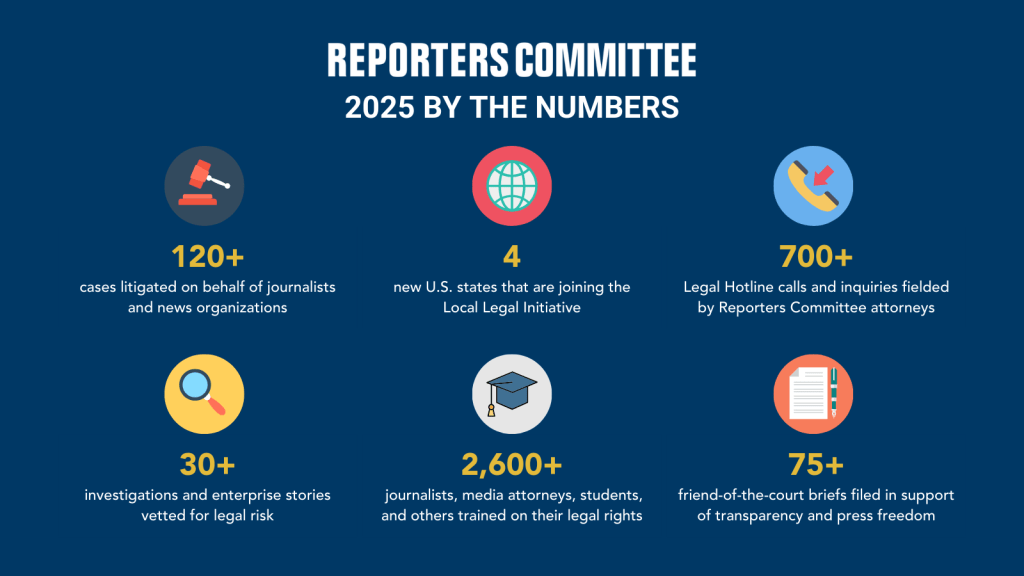
The free legal support our attorneys provided to journalists and news organizations resulted in court rulings striking down unconstitutional laws that made it a crime for journalists and others to closely observe and report on police activity in public. It also forced local school boards and a state university to be more transparent and accountable to the communities they serve.
In 2025, the reporting made possible by Reporters Committee attorneys’ legal support helped shed light on a government investigation into a sitting member of Congress, a powerful U.S. military contractor’s financial ties to Chinese investors, a state Medicaid agency’s failed response to a massive fraud scheme targeting Native Americans, and more.
Through our Local Legal Initiative, Reporters Committee attorneys continued their yearslong campaign to obtain police body-worn camera footage and other law enforcement records on behalf of local journalists and news outlets, fueling important investigative reporting about fatal police shootings and allegations of law enforcement misconduct. They also helped newsrooms push back against public universities’ censorship of student newspapers, fight for greater transparency and accountability in city, county, and state government, and unseal records related to the mysterious death of a former federal prosecutor.
To accomplish all of this essential work — and to meet the increasing demand for the Reporters Committee’s free legal services — the organization continued to expand throughout 2025. Led by Lisa Zycherman, who took over as vice president of legal programs this year, our legal team added an attorney to direct the Local Legal Initiative, leveled up our longtime national litigation program, and expanded the scope of our pre-publication review practice.
With funding from American Journalism Project, we also added a new attorney to ProJourn, which is in its fifth year of uniting law firms and corporate in-house counsel to train more non-media lawyers to provide legal support to local journalists and news outlets, in both English and Spanish. This lawyer has been a key part of ProJourn’s efforts to assist journalists in connecting with pro bono attorneys to navigate business legal needs. This year, the team led more than 80 checkups for newsrooms to help them proactively identify opportunities to bolster their legal health, thanks to the support of its more than 45 law firm and in-house legal team partners. ProJourn continues to develop its pre-publication review and access to public records programs as well, all in collaboration with longtime partners Microsoft, Davis Wright Tremaine, and the John S. and James L. Knight Foundation.
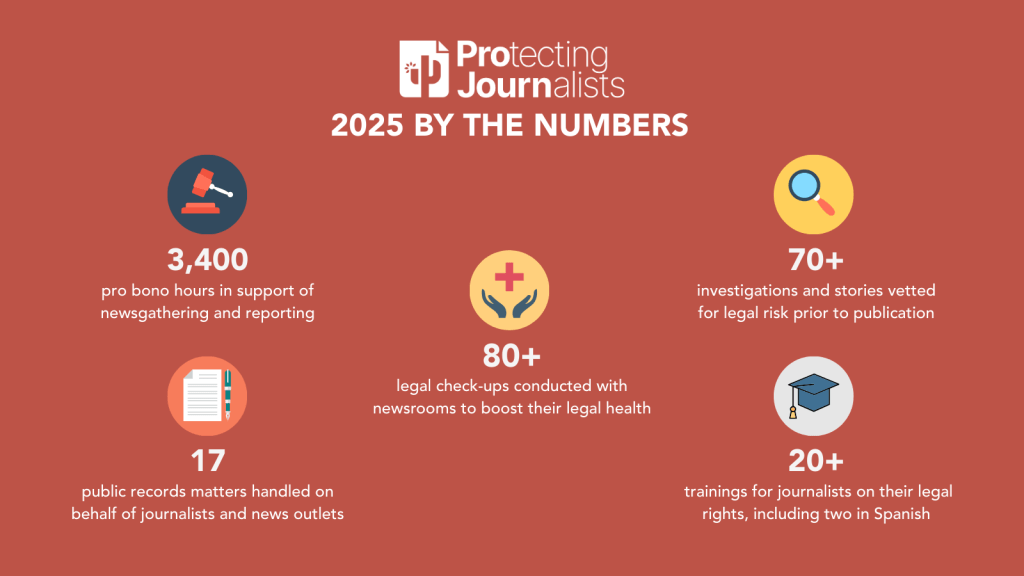
The Reporters Committee’s growth is made possible by the generosity of our supporters, including those who helped us raise an organizational record $2 million while honoring leaders in journalism and media law during our 2025 Freedom of the Press Awards. Next year, our expansion will continue as we nearly double the size of the Local Legal Initiative, launching the program in four new states: Louisiana, Michigan, Minnesota, and Mississippi.
For a more in-depth look at the Reporters Committee’s year, here’s a recap of the highlights.
Jump to a specific section below to examine our work in that issue area: Business |
Democracy and Elections | Education | Health | Immigration | National Security | Policing and Corrections | Celebrating Press Freedom
Business

Using court records obtained through successful litigation with free legal support from attorneys at the Reporters Committee and Shaw Keller LLP, ProPublica revealed SpaceX’s direct financial ties to Chinese investors.
“The newly unsealed testimony marks the first time direct Chinese investment in the company has been disclosed,” the nonprofit news outlet reported, “raising new questions about foreign ownership interests in one of America’s most important military contractors.”
Documents made public after a three-year court battle between Nike and a media coalition — represented by Reporters Committee attorneys — revealed the names of former and current Nike employees, including high-level executives, who were accused of sexual misconduct.
As The Oregonian reported, the information disclosed in the filings contradicts Nike’s previous public statements that internal complaints largely alleged managers below its executive ranks engaged in misconduct.

In February, The Markup and the Pulitzer Center’s AI Accountability Network published an investigation revealing that Match Group, the company behind over a dozen dating apps, failed to warn users of Tinder and other platforms about people it knew were accused of sexual violence.
The news outlets were able to tell the story of one abuser after fighting for access to court records with free legal support from Reporters Committee attorneys and Colorado attorney Steve Zansberg, with whom they connected through ProJourn. Those records were crucial to building a timeline that showed how safety lapses at Match Group allowed the accused rapist to keep preying on women.
Democracy and Elections
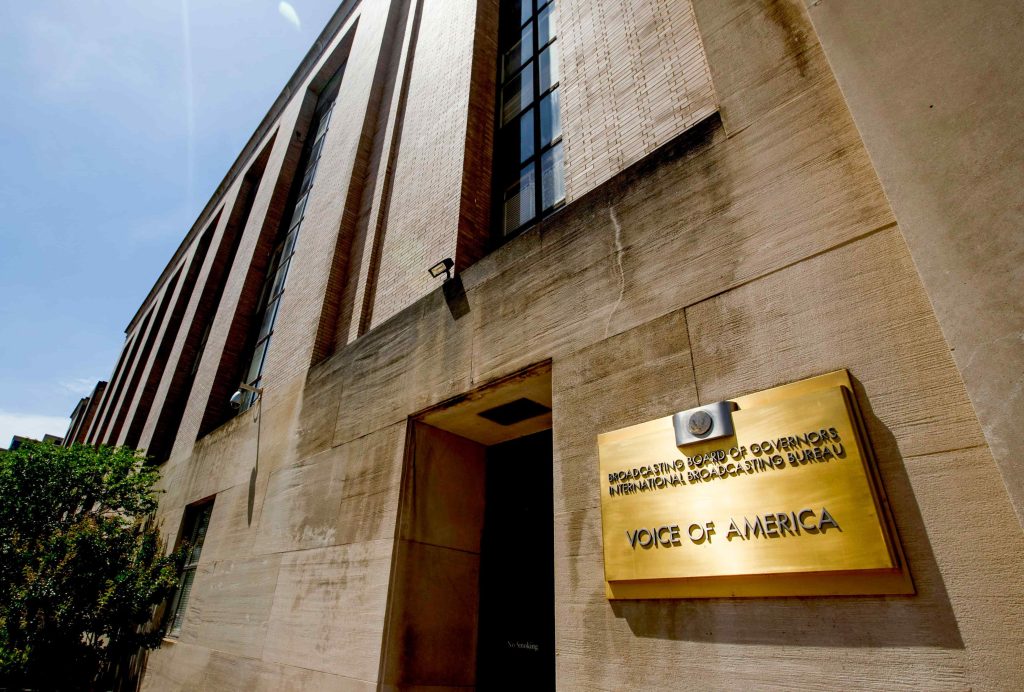
When the Trump administration ordered the dismantling of the U.S. Agency for Global Media, the federally funded agency that oversees Voice of America and other international broadcasters, the Reporters Committee moved quickly to help block those efforts in court.
In five separate friend-of-the-court briefs, filed in rapid succession under significant deadline pressure, the Reporters Committee supported lawsuits challenging President Donald Trump’s executive order targeting USAGM — whose networks, by law, are protected from political interference. The briefs argued that allowing the Trump administration to unilaterally gut the overseas broadcasters would sabotage the editorial independence that is essential to their credibility, their mission, and the safety of their reporters.
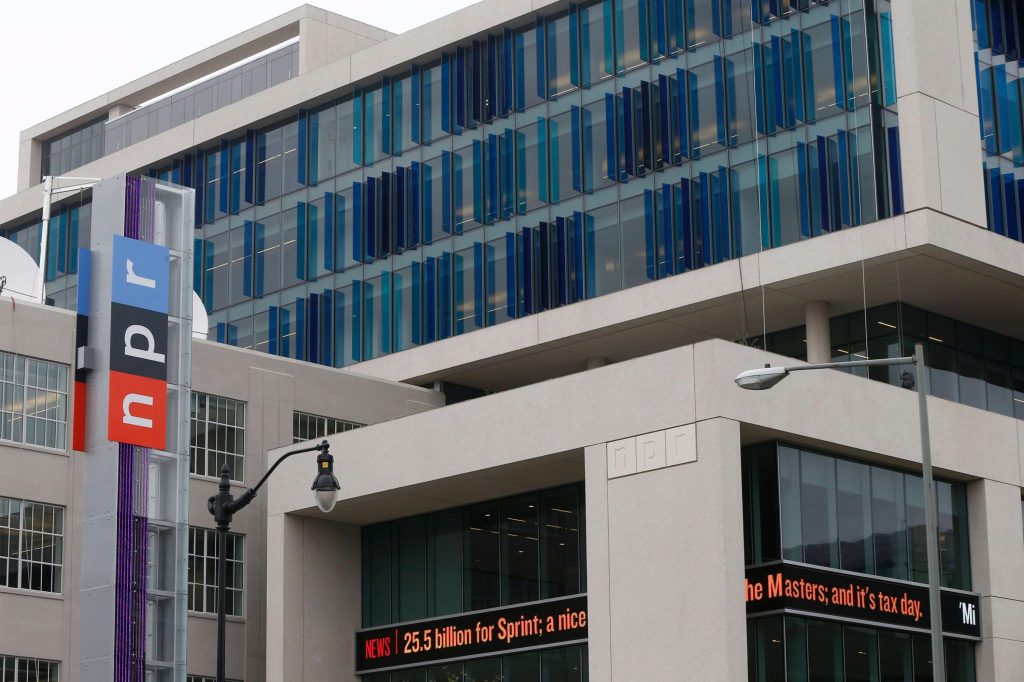
The Reporters Committee urged a federal court to rule that President Trump’s recent executive order targeting NPR is unconstitutional — and to block the government from enforcing it.
In a friend-of-the-court brief joined by 29 NPR member stations, the Reporters Committee argued that Trump’s order seeking to cancel direct funding to NPR and the Public Broadcasting Service “strikes at the heart of free speech and a free press, undermining the central purpose of the First Amendment.”
A Tennessee judge ruled that the Chattanooga City Council violated the state’s Open Meetings Act during the process of creating new voting districts for local elections, siding with arguments that Reporters Committee attorneys made in a lawsuit on behalf of the Chattanooga Times Free Press.
“This ruling sends a strong message to city and county officials across Tennessee that decisions about the public’s business cannot be made behind closed doors,” said Paul McAdoo, the Reporters Committee’s Local Legal Initiative attorney for Tennessee.

After a yearslong legal battle, the U.S. Department of Justice released a redacted affidavit related to the government’s seizure of U.S. Rep. Scott Perry’s (R-Pa.) cellphone as part of its investigation into efforts to overturn the 2020 election.
The disclosure came after a coalition of Pennsylvania news organizations, represented by Reporters Committee attorneys, successfully challenged the sealing of a wide range of records. As coalition member PennLive reported, the 83-page affidavit “add[s] another layer to the stack of evidence showing that Perry … worked feverishly in the last weeks of Trump’s term to help him cling to power.”
Education
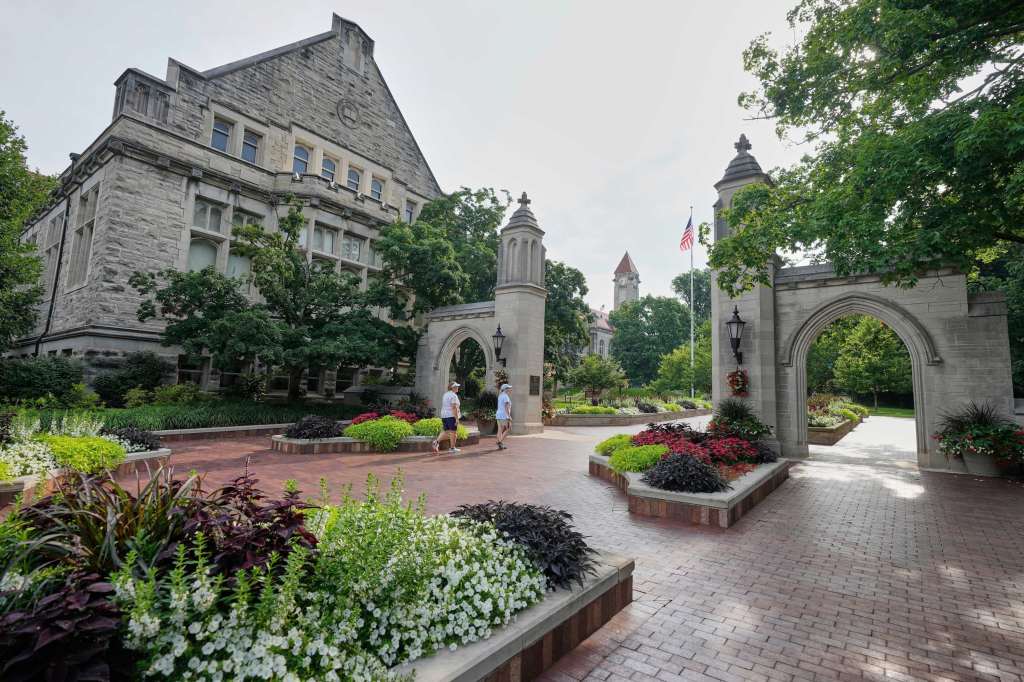
Facing pressure from Reporters Committee Local Legal Initiative Attorney Kris Cundiff, Indiana University backed down from its decision to stop the Indiana Daily Student from printing news in the campus newspaper.
The reversal came after Cundiff challenged the university’s censorship of the newspaper on behalf of student journalists Mia Hilkowitz and Andrew Miller, arguing in a letter that the school’s decision to fire the newspaper’s adviser and cut future print editions of the paper were “ill-advised, unconstitutional, and appear to be aimed at suppressing core press and speech rights.”
Reporters Committee attorneys also pushed back against similar efforts to silence student newspapers at Purdue University and the University of Central Oklahoma.
With free legal support from Reporters Committee Local Legal Initiative Attorney Paula Knudsen Burke, Spotlight PA won two important victories in its fight for increased transparency and accountability at Penn State University.
In June, Burke helped the nonprofit news outlet settle its open meetings lawsuit against the university’s governing body. As part of the settlement, Penn State’s Board of Trustees said it would provide training for individual trustees focused on Pennsylvania’s Sunshine Act, and offer more detailed disclosures regarding the reasons for holding nonpublic meetings.
And in October, a Pennsylvania court ordered the state Department of Education to provide Spotlight PA with internal Penn State University Board of Trustees records that could shed light on how public officials are characterizing the university’s budget challenges. The court sided with arguments made by Burke and Heather E. Murray of the Cornell Law School First Amendment Clinic, who represented Spotlight PA and one of its reporters.
Health
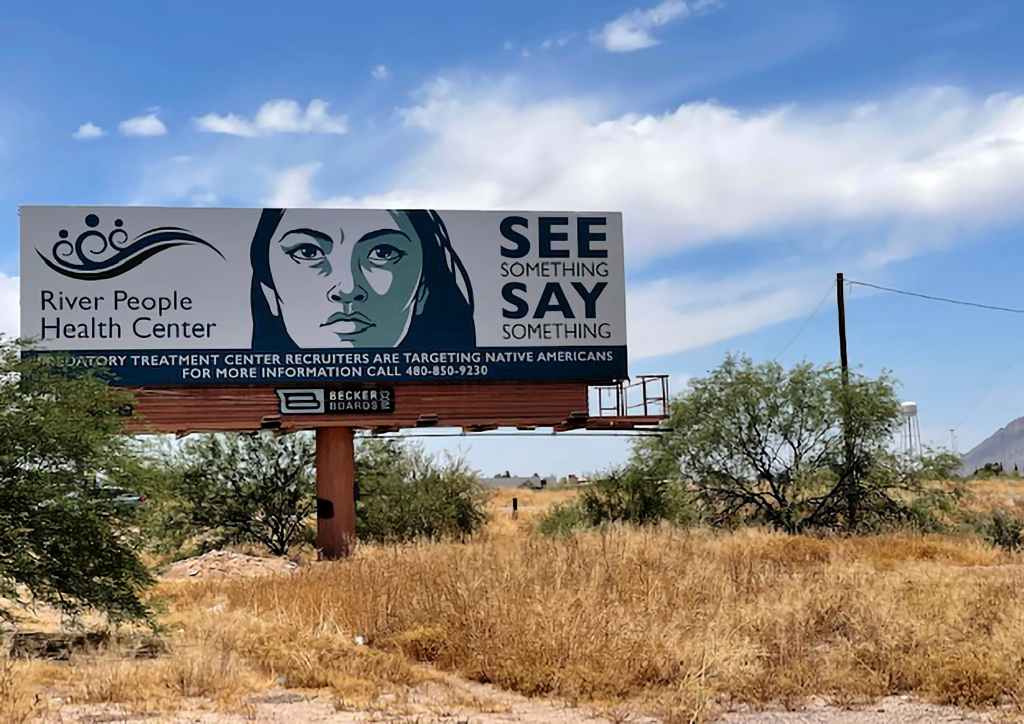
Using records obtained with the help of Reporters Committee attorneys, the Arizona Center for Investigative Reporting and ProPublica published an investigation that found that dozens of Native Americans suffering from addiction in Arizona died as the state struggled to address a massive Medicaid fraud scheme that cost taxpayers roughly $2.5 billion.
“These are public documents that articulate in detail an agency’s response in real time to a massive crisis that ultimately cost taxpayers billions of dollars and dozens of people lost their lives,” AZCIR Executive Director Brandon Quester told the Reporters Committee. “Without that legal support, we couldn’t have pulled back that veil of secrecy within the agency of how they were responding and when.”
Immigration

In April, the Reporters Committee published a new guide to help journalists understand the legal issues they may encounter while reporting on the federal government’s immigration crackdown and mass deportation campaign.
The Immigration Reporting Legal Guide, available in English and Spanish, is packed with information journalists can use to navigate coverage of America’s immigration system. This includes tips on filing relevant Freedom of Information Act requests, how to report on removal proceedings in court, and advice for recording the actions of immigration officers on the ground.
Throughout the year, Reporters Committee attorneys also conducted trainings to help journalists understand their legal rights and potential risks when covering immigration enforcement actions.
In a letter to Secretary of Homeland Security Kristi Noem, the Reporters Committee called out several troubling incidents in which federal agents arrested and used force against journalists — insisting that the agency instruct its officers in the field to recognize the First Amendment rights of reporters.
“The disturbing detentions, arrests, and physical attacks that we have seen in recent weeks targeting journalists covering the actions of federal law enforcement officers raise serious First Amendment concerns, especially at a time when there is intense public interest in how the government is applying our nation’s immigration laws,” Reporters Committee Vice President of Policy Gabe Rottman said.
Separately, the Reporters Committee urged the U.S. Department of Homeland Security to abandon proposed changes to foreign journalist visas, arguing that they could chill newsgathering and reporting and create a risk for U.S. journalists abroad.

The Reporters Committee spent much of the year urging federal courts to limit restrictions on remote public access to records filed in immigration cases so that members of the press and public can more easily monitor the government’s enforcement actions.
Through litigation, Reporters Committee attorneys helped The Intercept obtain an order from a federal appeals court lifting restrictions that prevented the public from accessing electronic court records filed in Georgetown scholar Badar Khan Suri’s high-profile immigration case. “This order is an important first step in bringing greater transparency to federal immigration proceedings that have become front-page news,” said Lisa Zycherman, the Reporters Committee’s vice president of legal programs.
National Security
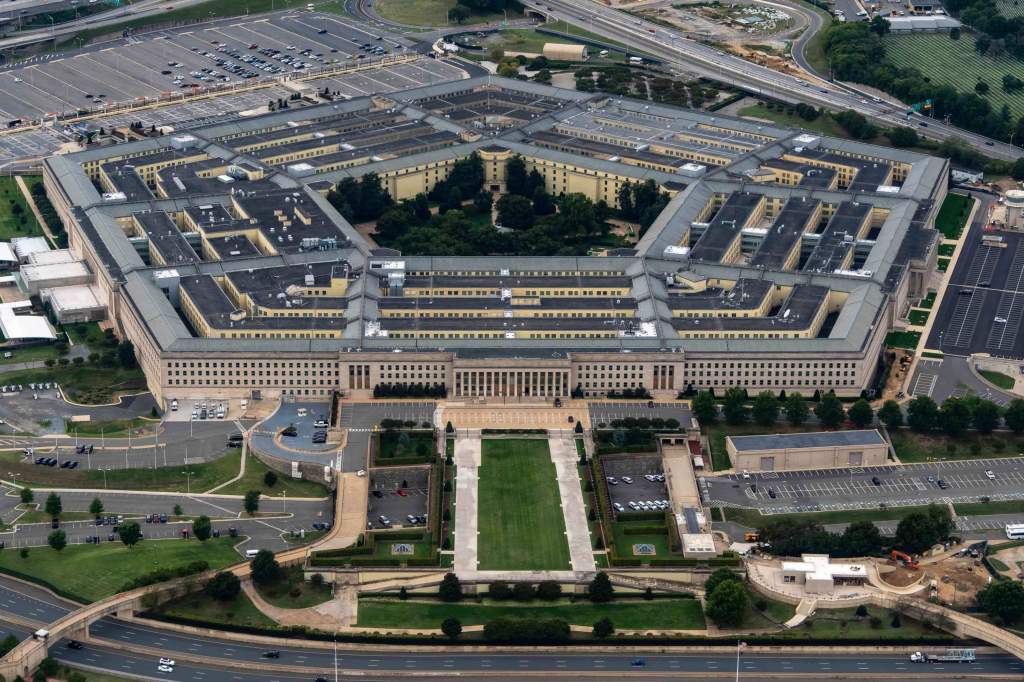
The Reporters Committee pushed back against a dangerous Pentagon policy that required journalists covering the military to sign a document pledging that they would not report information without the prior approval of government officials, even if it’s unclassified.
Reporters Committee attorneys then coordinated negotiations between news outlets and Pentagon officials in an attempt to resolve concerns with the restrictions, resulting in the release of a revised policy. However, the new policy still included language that threatened to impede newsgathering and reporting. Almost the entire Pentagon press corps refused to sign it, choosing instead to turn in their press badges, pack up their belongings, and walk out of the building.
In September, a federal court in California ruled that the public has a First Amendment right of access to military court proceedings and related records, largely siding with ProPublica in its lawsuit against the U.S. Navy and the U.S. Department of Defense.
The Reporters Committee led a media coalition in filing a friend-of-the-court brief in support of ProPublica urging the district court to safeguard that right so that journalists are able to report on military proceedings.
Policing and Corrections
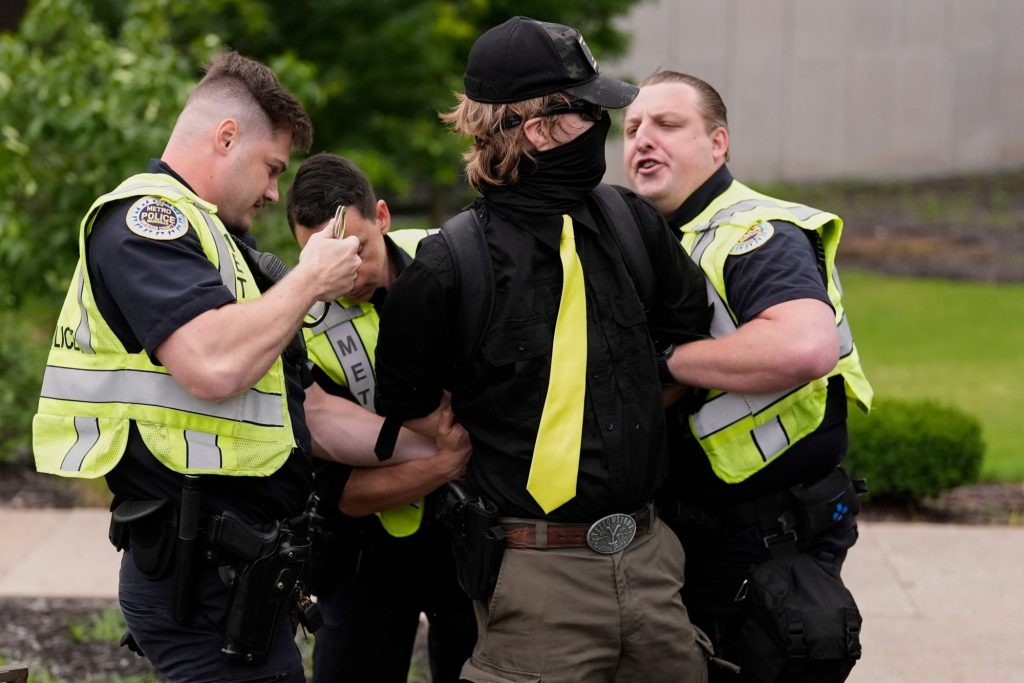
In a huge win for press freedom, a federal appeals court struck down an Indiana law that makes it a crime to approach within 25 feet of a law enforcement officer after being told to stop, finding it unconstitutionally vague.
The ruling marked the latest victory in our ongoing fight against so-called police “buffer zone” laws, which interfere with journalists’ right to gather news and report on law enforcement activity. It came after favorable decisions by district courts in legal challenges filed by Reporters Committee attorneys in Indiana and Louisiana, both of which also struck down the laws for being unconstitutionally vague. In July, Reporters Committee attorneys filed a third lawsuit on behalf of a media coalition challenging a substantially similar law in Tennessee.
“These buffer zone laws jeopardize reporters’ ability to bring their communities some of the news that matters most,” said Reporters Committee Staff Attorney Grayson Clary, “and it’s critical that federal courts continue to block states from enforcing them.”
In Indiana and Tennessee, Reporters Committee attorneys filed two separate lawsuits challenging the constitutionality of state restrictions on press access to witness executions.
The lawsuits are part of a broader Reporters Committee push to help journalists fight for transparency around capital punishment, including a second case in Indiana seeking public records about what the state paid for execution drugs.
As Reporters Committee Local Legal Initiative Attorney Kris Cundiff wrote in an op-ed for the Indiana Capital Chronicle, “when the government carries out its ultimate punishment in the public’s name, it cannot be allowed to do so in secret.”

Through litigation, Reporters Committee attorneys helped local newsrooms obtain access to police bodycam and dashcam videos that enabled the public to better understand the circumstances surrounding fatal police shootings and other law enforcement actions.
In Colorado, Reporters Committee Local Legal Initiative Attorney Rachael Johnson successfully litigated two separate bodycam cases on behalf of news outlets, resulting in the release of video footage that provided context for police shootings that killed a 37-year-old man and a 17-year-old girl.
And in Pennsylvania, Reporters Committee attorneys Paula Knudsen Burke and Gunita Singh helped newsrooms file several lawsuits this year seeking access to bodycam and dashcam footage under a restrictive law that governs access to recordings created by law enforcement agencies. In addition to securing access to videos through settlements, Reporters Committee attorneys obtained what appears to be the first court order granting a request to access police recordings under the law.
Celebrating Press Freedom

The 2025 Freedom of the Press Awards honored leaders in journalism and media law and raised over $2 million for the Reporters Committee — making it the most financially successful Awards in the organization’s 55-year history! At a critical juncture for press freedom in the U.S., these funds will directly support our mission to provide free legal services to journalists nationwide.
Watch videos celebrating this year’s winners:
- Amanda Bennett, former CEO, U.S. Agency for Global Media
- Jeffrey Goldberg, editor-in-chief, The Atlantic
- Terry Baquet, co-founder and editor-in-chief, Verite News
- The Baltimore Banner
- Brad Kutrow, partner, McGuireWoods
The Reporters Committee also honored the legacy of John Thornton, co-founder of the American Journalism Project. Remarks from all of our honorees at the event are also available on YouTube.